Subterranean termite activity in Brown County centers entirely on soil-to-wood contact and high-moisture perimeter conditions. Eastern subterranean termites navigate through subterranean gallery networks beneath the…
Subterranean termite activity in Brown County centers entirely on soil-to-wood contact and high-moisture perimeter conditions. Eastern subterranean termites navigate through subterranean gallery networks beneath the regional frost line, constructing earthen shelter tubes over poured concrete, masonry blocks, and sill plates. In neighborhoods like Moccasin Creek, Prairiewood, and the Melgaard Park Area, seasonal alluvial water tables force colonies toward residential sill plates and structural band joists. Standard surface insecticide applications fail against these pests because subterranean colonies nest deep below grade, requiring specialized non-repellent termiticide barriers or targeted low-profile bait grids to achieve true structural isolation.
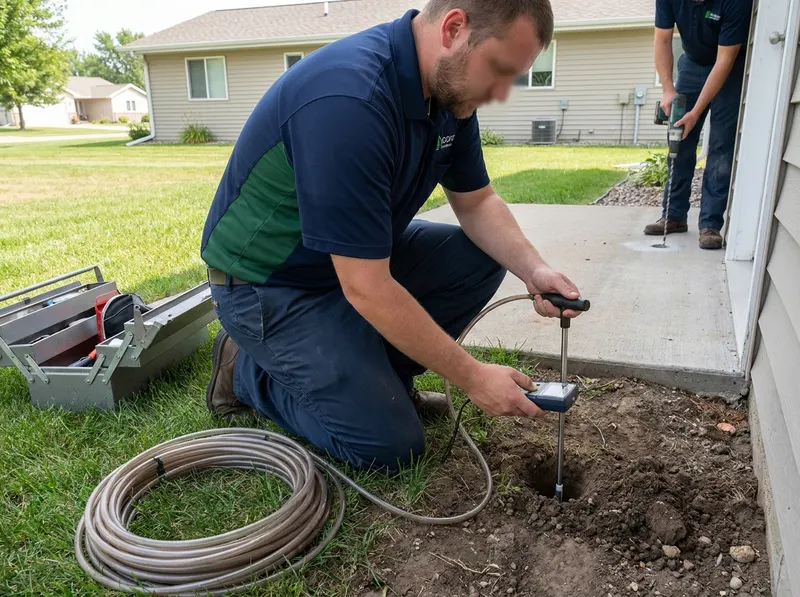
Diagnostic containment demands precision linear installation rather than broadcast spraying. Liquid barrier defense involves trenching soil adjacent to foundation walls down to minimum depths of 6 inches, followed by controlled hydraulic injection at 4 gallons per 10 linear feet. Where flatwork abuts a foundation, such as attached garages in Rolling Hills or North Highland, and basement walkouts near the Lincoln Park District, technicians drill concrete on 12-inch centers to inject termiticide directly into underlying soil beds. For crawlspace foundations found in older properties throughout the Northern State University Area, perimeter rodding isolates interior support piers from foraging galleries originating outside the stem wall.
Choosing between continuous liquid termiticide barriers and exterior subterranean baiting networks depends on foundation construction and proximity to open surface water. Properties within 100 feet of Moccasin Creek or neighborhood drainage basins often utilize cellular bait systems containing insect growth regulators like noviflumuron to avoid soil-leaching concerns. Standard continuous liquid treatments provide immediate perimeter exclusion, whereas bait matrix stations require 60 to 90 days for foraging worker ingestion and subsequent colony collapse through trophallaxis. Both methodologies require an initial baseline inspection to verify whether mud tubes on foundational concrete represent active transit or historical shelter evidence.
Every job gets a firm, written price after a free on-site visit.
Tell us about your subterranean termite diagnostic barrier defense job in Aberdeen and we'll send a clear, written quote, usually the same day.
 Kelvoro Pest Management