Autumn weather transitions across Brown County trigger mass migrations of boxelder bugs and stink bugs toward artificial heat sinks. Residential properties near mature seed-bearing female boxelder and ash tree…
Autumn weather transitions across Brown County trigger mass migrations of boxelder bugs and stink bugs toward artificial heat sinks. Residential properties near mature seed-bearing female boxelder and ash tree clusters, such as those surrounding Melgaard Park Area, Moccasin Creek, and the Northern State University Area, frequently encounter thousands of insects aggregating on sunny south-facing siding by mid-September. As nighttime ambient temperatures drop toward freezing, these pests crawl beneath siding lap joints, weep holes, and roof overhangs to overwinter inside wall voids. Once sealed within exterior wall insulation, heating cycles draw them inward through electrical fixtures and baseboards into occupied living spaces throughout the winter.
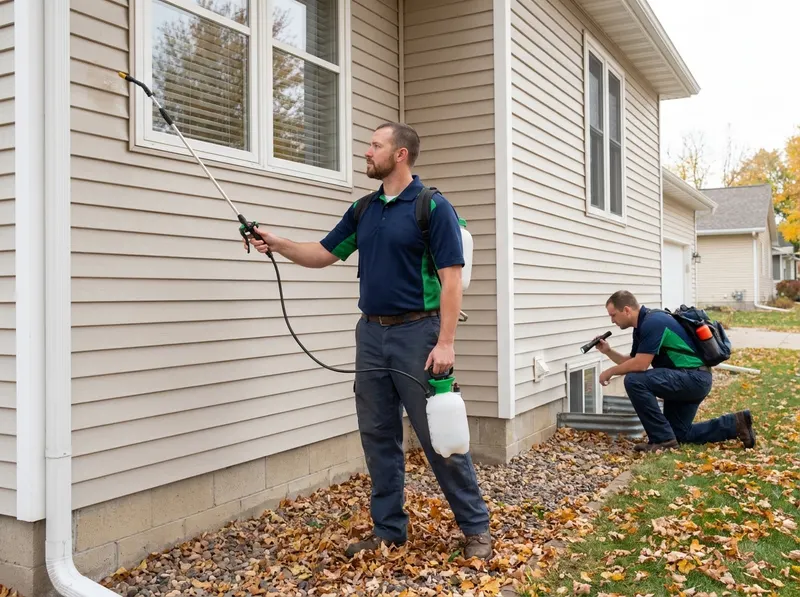
Effective seasonal control relies on timed exterior applications before interior wall migration occurs. Treating living areas with retail aerosol cans after insects enter drywall voids yields poor containment; dead insects decompose inside framing cavities, releasing defensive odor compounds and attracting secondary pests like dermestid carpet beetles. Professional abatement establishes a microencapsulated exterior chemical shield on foundation perimeters, masonry expansion joints, and high-exposure fascia. This barrier neutralizes aggregating adult populations on contact before they compress into architectural seams, bypassing the need for heavy pesticide distribution within indoor bedrooms or kitchens.
Homeowners selecting between preventive late-summer applications and mid-winter reactive containment face distinct trade-offs. An August-through-October exterior residual barrier stops structural ingress entirely, maintaining a clear exterior perimeter. Conversely, winter containment requires interior wall void vacuum extraction and light-fixture exclusion without the capacity to fully reach deep framing cavities until spring emergence. In high-exposure districts like Rolling Hills, Prairiewood, and properties bordering the Storybook Land Area, pairing late-summer chemical barriers with silicone-based caulking on window frames provides reliable exclusion through sustained sub-zero temperatures.
Every job gets a firm, written price after a free on-site visit.
Tell us about your seasonal boxelder bug and stink bug abatement job in Aberdeen and we'll send a clear, written quote, usually the same day.
 Kelvoro Pest Management