Exterior perimeter barriers focus environmental interventions where arthropods first contact residential building architecture. In Brown County, fluctuating seasonal surface conditions drive crawling pests toward the…
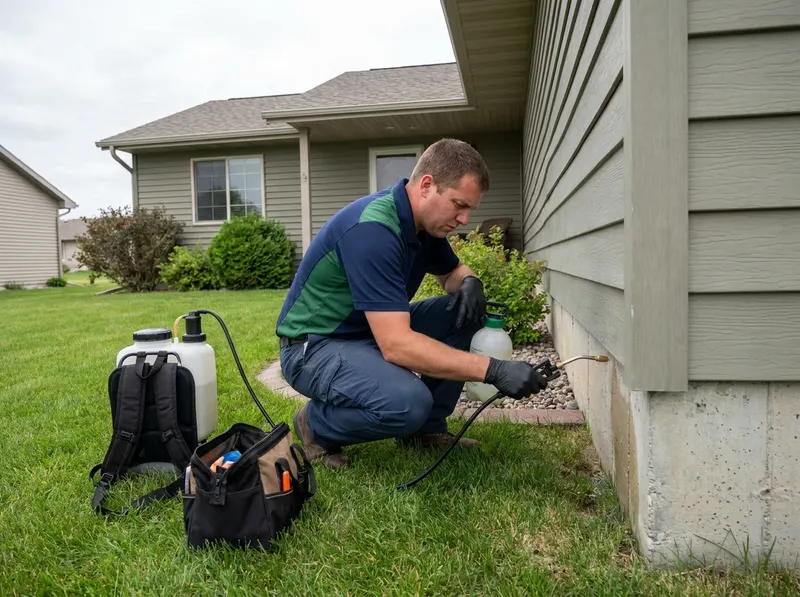
Exterior perimeter barriers focus environmental interventions where arthropods first contact residential building architecture. In Brown County, fluctuating seasonal surface conditions drive crawling pests toward the thermal and structural expansion gaps of exterior foundations. In early summer, pavement ants and odorous house ants push outward from hard-packed soils into siding gaps, while autumn temperature drops drive wolf spiders and yellow sac spiders into lower wall voids. Traditional interior aerosol sprays target individual insects after indoor infiltration has occurred, distributing volatile materials near living areas without halting the outdoor source colony. A dedicated external liquid microencapsulated or wettable powder perimeter barrier binds directly to concrete masonry units, poured concrete, and base siding to intercept foraging insects outdoors. The non-repellent formulation allows crawling insects to pass through the microscopic barrier matrix, transferring active chemistries through ant colonies or picking up lethal contact doses on spider tarsi before indoor nesting can establish.
Property layout directly influences barrier deployment throughout Aberdeen neighborhoods. Homes bordering drainage swales and open turf, such as in Prairiewood and Rolling Hills, encounter dense wolf spider populations that migrate across large lawns toward crawl space vents and low-profile deck footings. Properties along Moccasin Creek, the Melgaard Park Area, and the Lincoln Park District often feature mature root systems and ornamental river-rock beds that retain foundation moisture, harboring substantial subterranean ant colonies against foundation perimeters. In older, high-density residential architecture near the Northern State University Area and North Highland, cracked mortar joints and historical foundation transitions require precise sub-surface injections and targeted granular applications. Farther northwest near the Storybook Land Area, open prairie winds drive seasonal arachnids toward lee-side structural walls. A systematic perimeter application applies a continuous 3-foot vertical liquid band up the foundation masonry, balanced by a 3-foot horizontal swath along adjacent soil, gravel, or turf borders. Specialized micro-dusting in vinyl siding weep holes and expansion joint voids seals micro-crevices without contaminating interior living zones.
Perimeter barrier installations are engineered to withstand the extreme precipitation and temperature swings typical of the Northern Plains. High-exposure foundation exposures common to rural Brown County properties undergo UV degradation and heavy thermal cycling, requiring photostable chemical compounds that bind securely to structural aggregates. If continuous soil moisture persists from poor grading or blocked downspouts, corrective exterior physical adjustments must accompany barrier work, as standing water breaks down liquid barrier films prematurely. For properties with severe indoor ant nesting already present inside wall framing, an external barrier isolates the indoor satellite colony, necessitating supplementary interior gel-baiting to resolve the indoor infestation while the perimeter prevents external replenishment.
Every job gets a firm, written price after a free on-site visit.
Tell us about your perimeter ant and spider barrier service job in Aberdeen and we'll send a clear, written quote, usually the same day.
 Kelvoro Pest Management