Stinging insect activity in Brown County intensifies sharply from June through September. Queen wasps emerge from winter harborage beneath loose siding and tree bark during late spring, establishing exploratory…
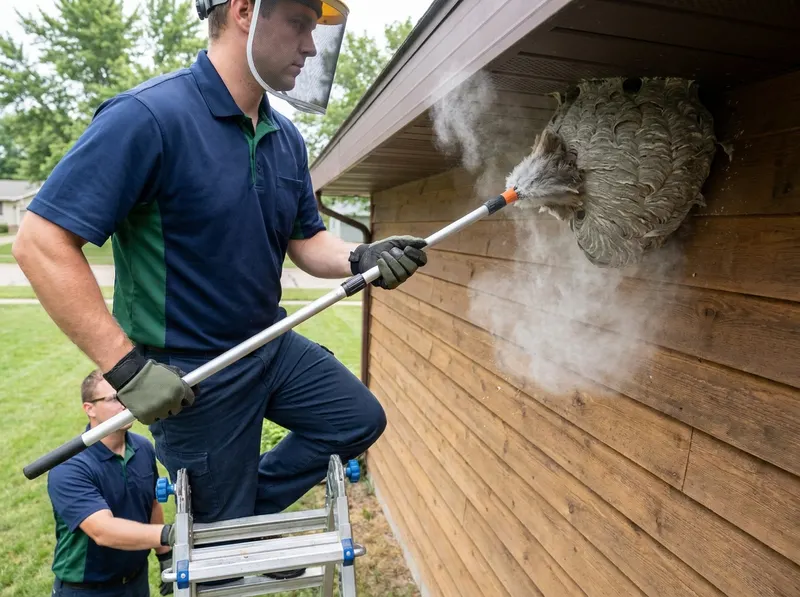
Stinging insect activity in Brown County intensifies sharply from June through September. Queen wasps emerge from winter harborage beneath loose siding and tree bark during late spring, establishing exploratory colonies that accelerate into aggressive populations by mid-summer. In the Melgaard Park Area and Moccasin Creek corridors, dense mature canopies and nearby water sources foster substantial bald-faced hornet activity, leading to heavy football-shaped carton nests anchored high in cottonwoods, maples, and residential soffits. Conversely, open-exposure properties in Prairiewood and Rolling Hills experience persistent paper wasp colonization under structural fascia, rafter tails, and deck framing, while ground-nesting yellowjackets frequently occupy abandoned rodent burrows throughout turf edges near Lincoln Park District and North Highland.
Controlling aggressive vespid colonies requires decisive containment rather than off-the-shelf aerosol sprays. Supermarket pesticide cans deliver low-volume pyrethroids that agitate the colony, prompting defensive swarming toward nearby doors, windows, and family outdoor spaces. In advanced scenarios where yellowjackets enter behind exterior mortar joints, brick weep holes, or vinyl soffits near the Northern State University Area, localized spraying drives workers deeper through the wall voids into residential sheetrock, where they chew through ceiling drywall into interior bedrooms. Diagnostic removal isolates the primary flight path, injects specialized microencapsulated or insecticidal dust matrices directly into the central core, and executes physical extraction once worker traffic ceases.
Decision guidance relies on nest depth and placement. An external paper wasp comb visible under a ground-level deck rail represents an accessible surface treatment; a subterranean yellowjacket colony under a landscaping timber or a void nest behind aluminum siding necessitates directional pressure injection and progressive perimeter exclusion. The critical trade-off centers on structural intervention versus simple aerial detachment: exposed nests require rapid knock-down and detachment, whereas wall-void infestations require careful containment to kill the entire queen core without driving stinging workers inside the home. Every treatment concludes with a residual boundary barrier around adjacent soffits and entry eaves to deter secondary queens from reoccupying identical microclimates.
Every job gets a firm, written price after a free on-site visit.
Tell us about your stinging insect and wasp nest removal job in Aberdeen and we'll send a clear, written quote, usually the same day.
 Kelvoro Pest Management